How Much Does Drywall Installation Cost in NY (2026 Guide)?
Suppose you are a superintendent who is walking a half-finished floor and stops at the same wall twice. The framing and the layout are looking fine, but the drywall set has already shaken because one soffit, which is a framed, dropped ceiling section, has changed, one ceiling has dropped, and one fire-rated corridor has been reworked.
It is where a drywall project budget increases during actual installation. This starts when an estimating team skips some central points in the cost assessment. That is the real story behind the drywall installation cost in NY. The project estimate depends on project scope, board type, finish level, and labor. Let’s explore more on this topic!
Average Cost to Install Drywall in New York
Total drywall installation cost is $987 to $3,216, with $2,101 as the average. New York City metro drywall installers average $31.89 per hour, while construction laborers average $32.80 per hour. That local wage pressure matters.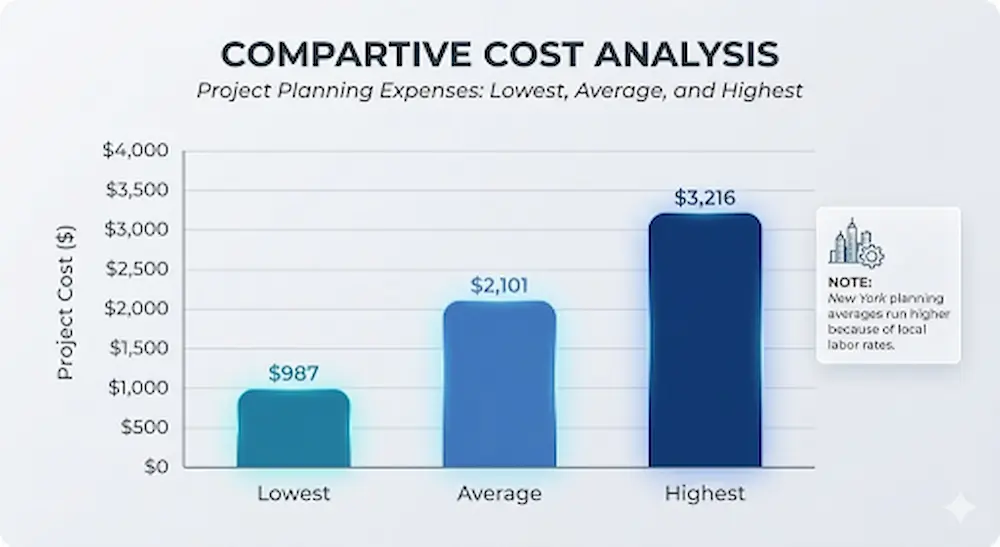
What Factors Affect the Drywall Installation Cost?
Drywall pricing looks simple until the drawings get real. Then the number starts reacting to room shape, board type, finish level, access, and labor conditions. Labor alone can make up about 70% of the installed price, so even a small productivity change moves the total fast.
Let’s see the factors that impact the drywall installation cost
-
Project Scope
Project scope drives labor hours. Suppose you are dealing with two projects: a standard room with simple framing and a room with bulkheads, rounded corners, and tall ceilings. Both projects will cost differently due to a change in the complexity level. In a complex project, the details will add more cost due to the addition of cuts, lifts, and time on layout.
Older homes also add risk. Lead paint, asbestos, or mold can add $1,000 to $3,000+ before the drywall project starts, and removing old plaster can cost $1.50 to $3 per square foot.
| Task | Cost Pressure |
| Flat, open room | Low |
| Tall ceilings | Medium to high |
| Rounded corners | High |
| Arched openings | High |
| Old plaster removal | High |
| Lead, asbestos, or mold work | Very high |
-
Type of Drywall
Material choice changes the drywall takeoff immediately. Standard drywall is cheapest, but specialty boards make sense in the right rooms. Moisture-resistant panels, mold-resistant panels, fire-resistant boards, and soundproof boards are all used in different places, and also cost differently. See the table below for details.
| Drywall Type | Best Use | Material Cost/sq. ft. |
| Moisture-resistant | Bathrooms, kitchens | $0.55–$0.70 |
| Mold-resistant | Wet areas | $0.65–$0.75 |
| Fire-resistant | Garages, boiler rooms | $0.55–$0.90 |
| Soundproof | Bedrooms, media rooms | $1.85–$3.00 |
| Eco-friendly | General interiors | $0.70–$0.90 |
This table explains why one wall feels cheap and another one does not. The board specification sets the tone before labor starts the project.
-
Thickness of Drywall
The thickness of a drywall affects cost, weight, handling, and sometimes the code path. Whether you consider quarter-inch panels or half-inch panels, both are used for different purposes and give different cost data. Below is the table showing the different sizes of drywall, along with the best use and cost per panel.
| Panel Thickness | Best Use | Average Cost Per Panel |
| 1/4 inch | Curves, patches | $15 |
| 3/8 inch | Repairs | $16 |
| 1/2 inch | Standard walls | $20 |
| 5/8 inch | Ceilings, fire-rated work | $21 |
| 3/4 inch | Soundproofing, fireproofing | $23 |
Note: A 5/8-inch board often wins on performance, but it costs more to move, hang, and finish.
-
Finishing Level
The finish level is where many drywall budgets change. From Level 0 to 5, all are used with different specifications and costs. See the details in the table below.
| Finish Level | Description | Average Cost / sq. ft. |
| 0 | Hang only | $0.80–$1.00 |
| 1 | Tape and mud | $1.00–$2.00 |
| 2 | One coat compound | $1.25–$2.50 |
| 3 | Two coats compound | $1.50–$3.00 |
| 4 | Three coats compound | $1.65–$3.15 |
| 5 | Skim coat, premium finish | $2.00–$3.50 |
Pro Tip: Considering the basic finish can ruin your project because of a significant cost overrun. Therefore, you must always identify the best option among 5 and then invest.
-
Project Location
The location of a project can change everything in New York. According to Angi’s recent study, the average cost of drywall in New York is around $2,300, which is higher than in many other states. When it comes to labor, drywall installers in the state charge an average of $31.89 per hour, while the broader construction and extraction occupational group averages $37.83 per hour.
-
Labor Rates in NY
For accurate estimating, it’s never wise to rely on a single generic labor estimate. The smart approach is to break rates down by specific trade role, then load them properly with burden and margin. For all trades, you will see different market demands. See the details below.
| Role | Ave Rate Per Hour |
| Drywall and ceiling tile installers | $31.89/hr |
| Tapers | $30.89/hr |
| Construction laborers | $32.80/hr |
| Construction and extraction occupations | $37.83/hr |
Note: Those are wage numbers, not bill rates. Contractors still need payroll burden, supervision, insurance, overhead, and profit on top.
-
Site Preparation Needs
Site prep needs can increase the cost of a drywall installation. Before hanging new boards, teams may need to remove old wall coverings, repair framing, or handle moisture damage. Whatever the addition is, it will add expense to your project cost.
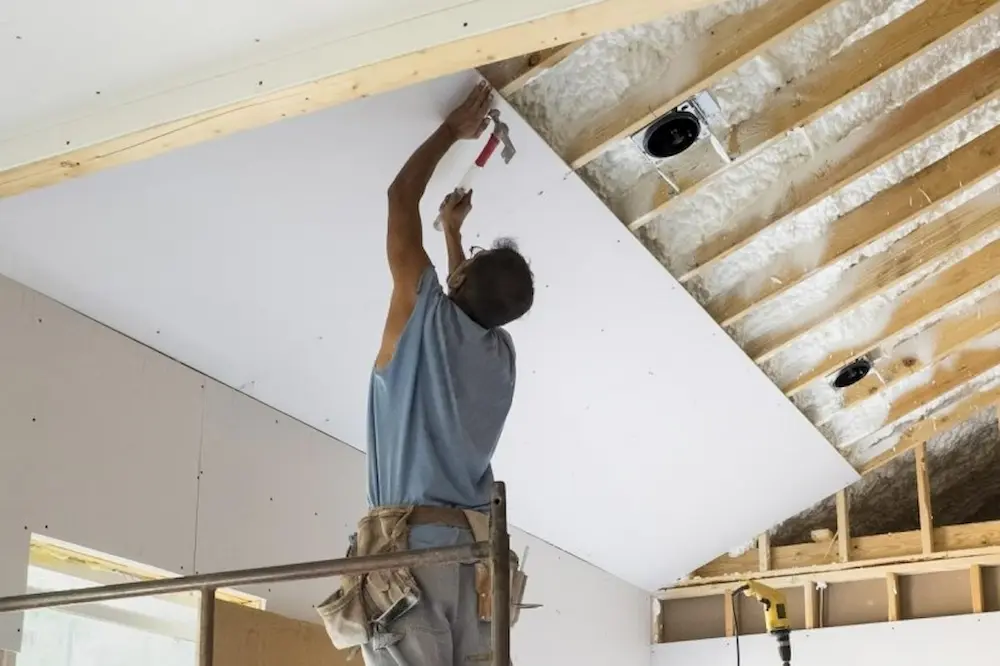 According to Angi’s report, wood paneling removal cost at $0.50 to $1 per square foot, and replacing plaster walls costs between $1.50 and $3 per square foot. In addition, permits can add $50 to $150 when layout changes demand them.
Pro Tip: Keep the site clean for easy startup; it will minus expense, helping contractors have more in margins.
-
Regional Economic Factors
In 2026, freight and fuel are moving around too fast to ignore. UPS notes fuel surcharges are adjusted on an index basis and can change without notice. Supply Chain Dive also reported that UPS ground fuel surcharges jumped from 21.5% to 25.5% across March 2026. That is parcel freight, not drywall delivery, but it proves that the transportation costs can increase fast.
For New York jobs, it’s smart to build in a modest delivery and fuel allowance rather than assuming freight costs will stay flat. That protection line will save your margins when material runs stretch longer than planned.
How to Save Money in a Drywall Installation Project
Savings usually come from perfect planning before starting a project. Below are some practical tips for you.
-
Plan the Drywall Project Layout Efficiently.
A cleaner layout means fewer cuts, fewer seams, and less waste. That alone reduces material overage and slows nothing down.
-
DIY High-Labor Tasks for Money Saving.
Do the prep yourself when it makes sense. You can also remove furniture, wall decor, and outlet covers. Confirm framing, insulation, and electrical work before the drywall team arrives. All these practices will cut labor hours, and hence their cost, too.
-
Buy Materials Directly, Not Middle Man.
Direct material buys and controls will help you watch board type, delivery timing, and waste allowance. It also keeps contractors from paying markups they did not plan for.
-
Schedule Drywall Installation During Slow Seasons.
When you plan the project significantly affects its cost. In New York, you can get better rates from drywall installers in winter since it is considered a slower season.
-
Use Standard Materials for Drywall Installation.
Standard-sized drywall sheets are usually cheaper and easier to install. That lowers both purchase cost and labor demand.
-
Choose Lower Finish Levels When Possible.
If the space does not need a premium surface, a Level 3 or Level 4 finish can reduce your project cost. Level 5 is great, and it is expensive too.
-
Estimate the Drywall Project
A strong estimate protects the margin before the job starts. That is why careful takeoff work matters. A precise build plan, supported by How Much Does It Cost To Build A House In New York, gives the drywall line the context it needs. Therefore, you must start with that.
The Benefits of Estimating a Drywall Installation Project
A drywall estimate is only beneficial when it is precise and accurate. And when it is on point, you can gain the following benefits.
-
Accurate Material & Labor Calculation
A complete takeoff aligns board count, labor hours, finish level, and freight. That means fewer surprises when the installation starts.
-
Increased Bid Success/Bid-Hit Ratio
In construction, a 5:1 hit ratio is often considered a successful benchmark. Accurate estimating improves the odds because the bid lands in the right market band instead of guessing low or high.
-
Cost Management and Profitability
A right estimate protects markup. It keeps labor overruns, material waste, and scope issues from shaking the cost plans. Consequently, you submit solid bids that bring good profitability.
-
Faster Turnaround
Accurate drywall material counts streamline the rest of the tasks, which include procurement, material ordering, waste management, and above all, project scheduling. Simply put, it cuts the project lifecycle without affecting quality.
-
Improved Project Scheduling
Drywall work affects painters, electricians, finish carpenters, and inspectors. Right drywall estimates keep the next trade from getting jammed.
-
Professionalism
A precise drywall estimate signals control. It tells owners, architects, and builders that the estimates came from the specific project scope, not from a guess. That is the kind of confidence clients remember and trust.
How to Estimate the Drywall Installation Cost?
Precise and accurate drywall estimation starts with the drawing instead of an invoice. Plus, an estimate contains data on labor, materials, waste, project delivery, and finish requirements. Considering all these points, estimators providing drywall cost estimation services assess the cost of the project, following the steps below.
-
Calculate Project Size or Square Footage of the Drywall Project.
Following the estimators’ footprints, start with precise and accurate measurements. Break the job into walls, ceilings, soffits, bulkheads, and odd shapes. Then, total the square footage by area.
-
Determine Material Costs for the Drywall Installation Project.
A drywall construction takeoff should include sheets, tape, joint compound, screws, corner bead, fasteners, and any specialty boards. Considering the waste factor is integral in this phase of assessment. As a standard, you can take in 5-10% of the project total as a waste allowance.
-
Estimate Labor Costs for the Smooth Drywall Installation.
When it comes to labor, always first consider the productivity of the team. And after that, add the workers’ rate. For example, if a team performs at 20 square feet per hour, a 2,000 square foot job needs about 100 labor-hours. In NYC, drywall installers demand around $31.89 per hour, which equals $3,189 in direct wage cost before burden.
-
Include Extras for Accurate Estimation of a Drywall Project.
It is the point where contractors feel that drywall jobs are getting complicated because hidden expenses start showing up. Well, you need to add insulation, soundproofing, texture, disposal, inspection delays, and any electrical or plumbing adjustments costs in the report. They all show up during the installation of drywall. In addition, factor in taping, mudding, and texture finishing to stay on the safe side.
Mistakes to Avoid When Estimating a Drywall Project
Like other construction trades, drywall issues look simple to tackle on paper, but become complicated when they reach the construction site. Therefore, you must plan for them early; otherwise, they can reduce your margin significantly.
 Below are the common drywall estimating mistakes you must avoid:
-
Neglecting Waste Factor
A 5% to 10% waste buffer is normal for material estimating. Skipping it means the job starts getting thin. On a 2,500 square foot project at $2.50 per square foot, a 7% miss equals $437.50 in exposed material cost. In addition, on a 10,000 square foot project at $2.75 per square foot, the gap increases to $1,925.
-
Inaccurate Measurements
Inaccurate measurements during designing spread through the whole estimate. One wrong room dimension changes the sheet count, joint count, labor hours, and waste, hence affecting the drywall estimates. Therefore, takeoff should be conducted from a clean plan set, not rough drawings.
-
Overlooking Specialized Types
You have explored the different types of drywall above; all perform for different purposes and come with different prices. In different terms, moisture-resistant, mold-resistant, fire-resistant, and soundproof boards all carry different price points. If you ignore the specifications of the project or drywall, the estimate will miss the real material bill. So, never overlook specialized types of drywall when your target is to get accurate estimates.
-
Ignoring Finishing Needs
After having guidance on finish levels, you understand that a Level 5 finish costs more than a Level 3 finish. If the specification needs a smooth, paint-ready surface, the estimate has to carry the extra coats, sanding, and drying time, which will add extra cost to the project. Thus, always consider the finish level first, and then estimate the drywall project cost.
-
Ignoring Structural Obstacles
Rounded corners, arched doors, high ceilings, and intricate details all slow down drywall teams. And you know that more time means more labor cost; it’s a scheduling fact. Therefore, always factor in the complexities of the project and plan it accordingly.
-
Assuming Sheet Sizes
Do not assume every job wants the same board size. Manufacturers commonly list drywall in 4×8, 4×10, and 4×12 sheets. Bigger sheets can reduce seams, but they can also add handling stress. Go in-depth into your drywall project scope, get its specifications, and then decide on the best size suitable for your project.
FAQs
Why is it essential to consider the waste factor in the construction takeoff phase?
Factor in 5-10% of the project total expense as a waste coverage is essential since it supports keeping your project within budget limits when cuts, damage, or rework needs pop up.
What is included in the labor burden allowance in a drywall installation project?
Labor burden covers all the non-wage costs that pile on top of straight hourly pay. Things like workers’ compensation insurance, Social Security and Medicare taxes, unemployment insurance, health benefits, and retirement contributions are included.
What is the standard drywall sheet size in New York?
The standard sheet size is 4×8 feet in NY. However, 4×10 and 4×12 sheets are common for taller walls and fewer seams.
What is the bid-hit ratio in construction?
Bid-hit ratio gives the difference between how many bids a contractor submits and how many contracts they win. A common benchmark is recorded near 5:1, which means one win for every five bids.
How much do contractors save with accurate drywall estimates?
Accurate drywall estimates help avoid the normal 5% to 10% material buffer that many jobs need for waste, on a mid-size project scope, which can save hundreds of dollars. On larger New York jobs, it can save well over a thousand.
Conclusion
Drywall estimating in New York comes down to scope, board type, thickness, finish level, labor, and site conditions. The jobs that stay profitable usually start with accurate takeoff data and a realistic labor load. That is where a contractor takes the right or wrong path for a bid win or lose, respectively.
For contractors who want precise and accurate estimates for fewer financial surprises, NY Estimating can support your next project with focused drywall estimating services. We submit reports fast and with above 95% accuracy. Contact us for more details!


